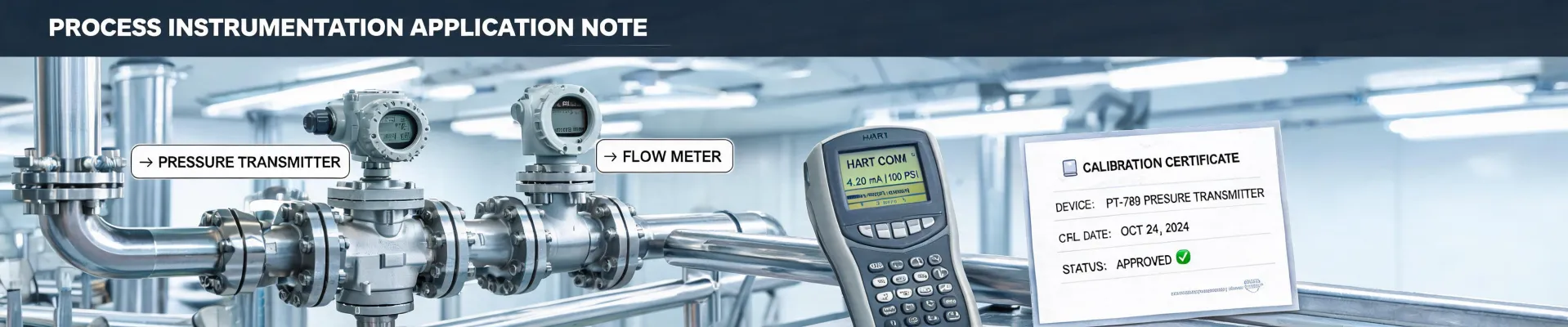
It was a Tuesday morning in March 2024 when I learned that “calibrated” and “calibration included” are two different things.
I handle procurement for a 14-person HVAC controls company. We don't have a metrology department. So when I buy instruments, I'm the person comparing quotes with a spreadsheet and hoping I'm not missing something. That morning's list had two Dwyer paddlewheel flow meters, a Dwyer pressure transmitter, a thermocouple calibrator, a digital micrometer, and an old Rice Lake load cell we needed to evaluate. Not a huge order. Around $4,800 — maybe $5,200; I would have to pull the old spreadsheet to be exact.
The night before the order
Dwyer was the easy part. I've used their instruments for six years, and I like that they publish real spec sheets. On Dwyer's home page, I found the exact flow range and fitting size for the paddlewheel flow meters in less than five minutes. No phone call needed. That part was a no-brainer.
The trouble was the thermocouple calibrator. We needed one to verify the temperature transmitters feeding our building automation system. I'm not a calibration engineer, so I can't speak to the internal accuracy of the calibrator. What I can tell you from a procurement perspective is that the certificate mattered more than the box.
Why the thermocouple calibrator quote almost fooled me
I asked three distributors to quote the same model. The first quote was $780. The second was $420 for the identical model. I almost clicked Buy on the $420 one. Then I read the fine print, and there it was: the calibration certificate was a $250 add-on. The $420 unit was “factory calibrated.” The $780 quote included a current NIST-traceable certificate. Same box, different total. So the spread wasn't $360. It was $110. That still matters, but it's not the same decision.
That's when I realized I'd been comparing base prices without comparing deliverables. Per FTC guidelines (ftc.gov), advertising has to be truthful and not misleading. But a spec sheet can say “calibrated” and still leave traceability in the fine print. It's not necessarily a lie. It's a hidden choice. I should have asked for “current NIST-traceable calibration certificate with data” in writing from the start.
In that conversation, I said “calibrated.” They heard “factory calibrated.” Result: a $250 surprise in the quote. I still don't know if the first quote was list price or a “we don't want small orders” number. My best guess is a bit of both, but I can't prove it.
Then another surprise. I called a small local distributor that didn't make me feel like my order was too small. The rep said, “We quote every customer the same.” I almost didn't believe him. Our order was only about $5,000, and I've had vendors ghost me for less.
What the $48 digital micrometer cost me
Now the part I'm not proud of. The digital micrometer. I found one for $48 online. The same basic style from a proper instrument supplier was around $220. I told myself the savings was worth the risk. Then the $48 micrometer digital display showed up with no datasheet, no stated accuracy, and no repeatability. It looked nice. It was a ruler with a battery. When our technician tested it on a 1.000-inch standard, it read 1.003, then 0.998, then 1.001. That red flag was all I needed.
Returning it cost $9.50. Reordering the $220 version cost an extra two days. And the two hours our tech spent testing the cheap one cost more than the difference. Net, I saved $172 and spent about $300. I'm not math-challenged, but that made me feel like one.
Maybe someone out there has found a $45 digital micrometer that works. I haven't. At least, that's been my experience in a professional setting.
How to test a Rice Lake load cell (the non-engineer version)
Back to the load cell. One quote for a replacement Rice Lake load cell was $640. Another was $980 for the same part number. Naturally, I wanted to be sure the old one was dead before spending that money. Here's how to test a Rice Lake load cell the practical way I did it, before calling a calibration lab.
- Disconnect the load cell from the indicator. If you skip this, you're measuring the indicator's input circuitry too.
- Find the nameplate and download the exact model's data sheet. Rice Lake load cells are commonly 350 ohm bridge resistance, but don't assume. The nameplate wins.
- Measure the resistance between the signal leads, SIG+ and SIG-. It should be close to the rated bridge resistance. Not open. Not a dead short.
- Measure between the excitation leads, EXC+ and EXC-. Same idea.
- Check isolation between the shield and each bridge wire. On our old load cell, the zero balance looked fine but the cable was leaking to the structure. Replacing the cable fixed it for $90.
- With a stable DC supply on EXC+ and EXC-, read the output between SIG+ and SIG-. At no load, it should be near zero. At full scale, it should be in the ballpark of the rated output on the nameplate.
Oh, and I should mention the indicator can lie. If the indicator is faulty, it can make a good load cell look bad. That's why the resistance tests come first.
I'm not an electrical engineer, so I can't talk about load cell theory beyond this. But from a procurement perspective, a load cell that fails a basic insulation test is probably not worth re-certifying.
What the final order actually cost
The local distributor's quote came to $5,620. It included two Dwyer paddlewheel flow meters, a Dwyer pressure transmitter, the thermocouple calibrator with a current certificate, a digital micrometer with an accuracy spec, and a spare temperature probe. It was $1,100 less than the next complete quote, and nine days faster than the national distributor's standard schedule.
Prices reflect quotes I received in March 2024. Check current rates before you plan any budget around them, because instrument pricing moves around more than people think.
When I thanked the rep, he said, “Today's small order may be tomorrow's order for a whole plant.” I don't know if he meant it, but he acted like it. That's rare.
“Today's small order may be tomorrow's order for a whole plant.”
Since then, I've built a simple total-cost spreadsheet: item, model, base price, certificate, shipping, lead time, support. It takes about ten minutes to fill out, and it caught two more incomplete quotes in six months.
Take it from someone who buys for a living
If you've ever stared at a quote sheet for thermocouple calibrators and wondered if you're being played, here is what I'd tell my past self:
- Compare complete quotes, not base prices.
- Ask for the calibration certificate by name.
- Don't buy a digital micrometer without a stated accuracy spec.
- Learn how to test a Rice Lake load cell before you're standing next to a scale pit with a multimeter.
- Treat suppliers who welcome small orders like gold.
Small doesn't mean unimportant. It means potential. In the months since that order, we've placed ten more orders with the same distributor, and I've stopped expecting invoice surprises. That's the real measurement: not just the $1,100 I saved, but the peace of mind that came from a vendor who actually wanted our business.
Bottom line: the cheapest quote is only cheap if every deliverable is in it.