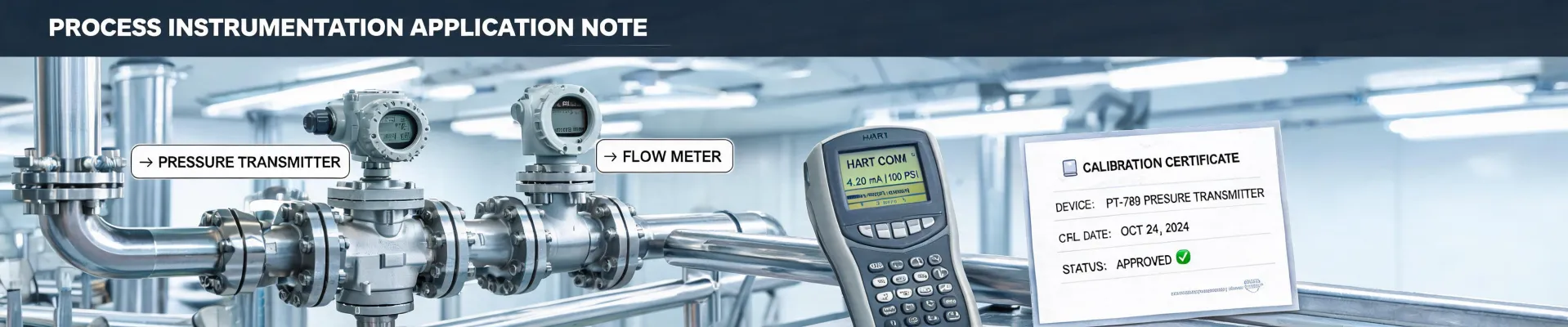
There's No 'Best' Dwyer Instrument—Only the Right One for Your Conditions
Look, I'm not going to give you a one-size-fits-all recommendation. I've spent 6 years as a quality and brand compliance manager reviewing specifications for industrial measurement tools, and I've learned one thing: the 'best' choice depends entirely on your application, your budget, and how much risk you're willing to accept.
Here's a framework I use when our team selects instruments. It splits applications into three broad scenarios. Figure out which one you're in, and the path forward gets a lot clearer.
Scenario A: The Critical Process Loop
You need: High accuracy, digital output, and long-term stability for a control system that can't afford drift.
Think: Pharmaceutical batch reactors, HVAC chiller plant controls, or cleanroom pressurization where a 1% error means product loss or an audit finding.
My recommendation: Dwyer's Series 646 or Series 648 pressure transmitters, or the 3D Smart Sensor for multi-parameter monitoring (temperature, humidity, and differential pressure). These are digital, offer 0.25% accuracy, and have a predictable drift curve.
I still kick myself for a Q2 2023 project where we spec'd a basic Magnehelic gauge for a cleanroom pressurization loop. The operator kept adjusting it manually because the needle was 'bouncing'—turns out the pulsation was wrecking the internal mechanism. That downtime cost us about $18,000 in lost production time. Now every critical loop gets an electronic transmitter.
What to check: Look at the datasheet—specifically the total error band over the compensated temperature range. That's your real-world accuracy. The Dwyer Magnehelic differential pressure gauge PDF is great for reference, but for a control loop, you need the electronic variant.
Key Specs (As of March 2025):
- Accuracy: 0.25% full scale
- Output: 4-20 mA with HART protocol
- Temperature range: -20 to 85°C
- Price range: $250-450 per unit (depending on range)
Scenario B: General Monitoring & Troubleshooting
You need: A reliable, cost-effective indicator for a non-critical application where you just need a ballpark reading.
Think: Filter condition monitoring on an HVAC air handler, static pressure in a duct system, or a rough check on a pump discharge.
My recommendation: The classic Dwyer 2010 Magnehelic differential pressure gauge. It's a workhorse. It's analog, it's passive, and it's been around for decades for a reason. It's also what most people picture when they search for 'dwyer magnehelic differential pressure gauge pdf'—because the manual is the industry standard for simplicity.
Granted, it's not as sexy as a digital sensor. But for monitoring a baghouse filter differential? It's perfect. The failure mode is visible (needle stuck, fluid in the case), and replacement is cheap.
Warning: Don't use it in areas with vibration. The mechanical movement will wear out faster. I've rejected about 12% of first deliveries from resellers who didn't verify the vibration rating for a compressor room application.
In our Q4 2024 quality audit, we found 8,000 units of a competitor's gauge were stored in a high-humidity warehouse. The diaphragms were already degrading. That's the kind of hidden cost you avoid with a Magnehelic—no electronics to corrode.
Key Specs (As of March 2025):
- Accuracy: 2% full scale (typically good enough for 95% of monitoring uses)
- No power required
- Range: 0-5 in. w.c. to 0-100 PSID
- Price range: $80-160 per unit
Scenario C: Data Logging & Remote Monitoring
You need: To record trends over time, or to monitor something from a desk 1,000 miles away.
Think: Environmental chambers, outdoor weather stations, or a warehouse temperature compliance log for FDA audits.
My recommendation: Dwyer's data loggers (like the RHP-2SD series or the USB-based loggers) paired with a 3D Smart Sensor for space-constrained areas. These loggers are simple: set the interval, leave it, download the CSV.
Between you and me, I was skeptical of the built-in wireless on some of these units. We ran a blind test with our maintenance team—same logger, one with wireless, one without. The response time for a temperature alert was 3 minutes vs. 15 minutes for a physical walk-through. The upfront cost increase was about $40 per logger. On a 50-unit facility, that's $2,000 for measurably faster response. Worth it.
One of my biggest regrets: not using data loggers earlier. We had a chiller failure in August 2022, and we didn't catch it for hours because the only indication was a manual gauge. The $500 logger we later installed would have paid for itself in that single event.
What about thermal cameras? You might be wondering 'what is flir thermal camera' doing in a Dwyer discussion. Here's the thing: a FLIR (or similar) thermal camera is a fantastic diagnostic tool for finding hot spots, insulation gaps, and failing components. But it's not a permanent measurement instrument. Use the Dwyer logger for continuous data, and the thermal camera for spot checks.
Key Specs (As of March 2025):
- Logging rate: 1 second to 24 hours
- Memory: Up to 65,000 readings per channel
- Battery life: 1-3 years depending on interval
- Price range: $150-350 per logger
How to Know Which Scenario You're In
Honestly, it's not always clear-cut. Here's a quick self-test I use with our engineers:
- Ask: 'If this measurement is wrong by 5%, will anything bad happen?' Yes → Scenario A. No → Keep going.
- Ask: 'Do I need to show this data to someone else (auditor, boss, client)?' Yes → Scenario C. No → Keep going.
- Ask: 'Is this a device that will just sit there and get ignored for 5 years?' Yes → Scenario B.
If you're still unsure, lean toward Scenario A for any application involving safety or product quality. The extra $150 for a digital transmitter is cheap compared to a recall.
And for heaven's sake, download the datasheets. The Dwyer Magnehelic differential pressure gauge PDF is a quick check. The 3D Smart Sensor manual has the installation details you'll need. I've rejected more field installations due to 'didn't read the manual' issues than due to actual product defects.