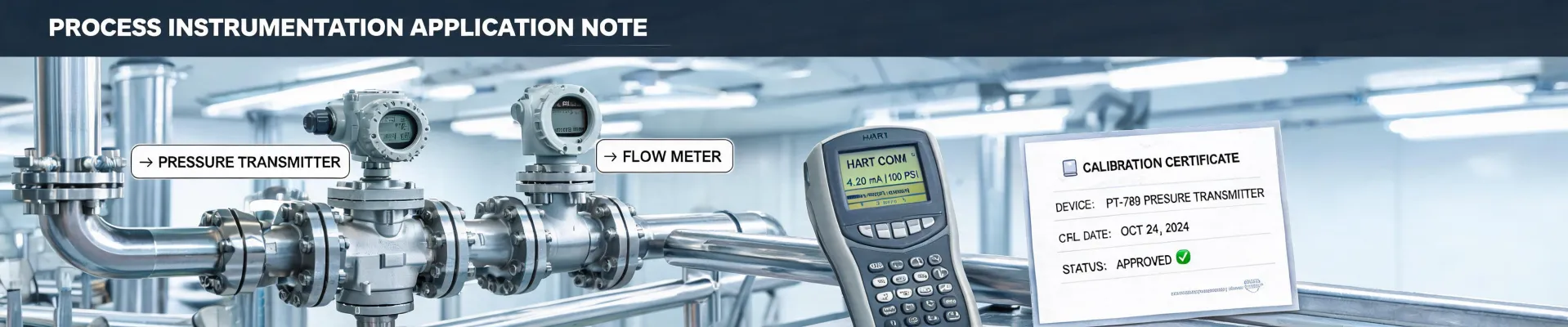
After five years of buying process instruments—pressure transmitters, turbine flow meters, thermal cameras, and a warehouse full of smaller stuff—I've landed on one conclusion: the price on the quote tells you what an instrument costs to buy, not what it costs to own. The cheapest vendor on paper has cost me more money than the most expensive one ever could. Once you start tracking total cost instead of purchase price, most of your buying decisions change.
How I learned this the hard way
I manage purchasing for a 75-person automation integrator. Since 2020, I've handled about $300K a year across 12 vendors—close to 400 orders total. Most of what I buy is measurement gear: dwyer pressure instruments, flow meters, thermocouples, and handheld test equipment.
In 2022, I bought a budget pressure transmitter to replace a failed unit in a paint booth. It cost about $400—half of what our regular supplier quoted for a dwyer instruments dp transmitter with similar specs. The savings felt like a win. Future me was not impressed.
The transmitter failed after eight months. Not gradually—it just stopped outputting a signal on a Tuesday morning. The paint booth's supply fan tripped, and the whole line had to stop until we could get a replacement installed. No, wait—the fan itself didn't trip. The monitoring system did. The fan kept running, but nobody trusted it, so they stopped the line anyway.
Total damage: $400 for the cheap transmitter, $180 in rush shipping, $950 for the replacement unit, and about $2,300 in labor and lost production. Call it $3,800 to save $400. I still have that spreadsheet, and it still makes me wince.
That was my turning point. Now I ask different questions before buying anything. What happens when this fails? How fast can I get a replacement? Does the vendor publish clear specs and pricing, or do I have to go back and forth to get a straight answer?
That last one matters more than I expected. I've learned to ask what's NOT included before I ask the price. A vendor who lists all fees upfront—even if the total looks higher—usually costs less in the end than one who surprises you later with freight, calibration certificates, and setup charges.
What I check before buying instruments now
- What accuracy do you actually need? For most HVAC and building monitoring, ±1% is fine. ±0.5% is comfortable. Paying for ±0.25% accuracy you don't need is a waste of money—I've been guilty of this.
- What's the straight pipe requirement? Turbine flow meters especially. If your installation doesn't have enough straight run upstream, the readings will lie to you and you'll blame the meter.
- Is the range right? A sensor running at 15% of its range is just as unhappy as one pegged at 100%. Buy so normal operation falls in the upper-middle of the spec.
- What's the lead time? A product that's $100 cheaper but takes six weeks to deliver is not $100 cheaper when your line is down.
What I'd buy again—and what I'd change
DP transmitters: don't overbuy accuracy
We use dwyer instruments dp transmitter models for filter monitoring and duct pressure in a lot of buildings. For those applications, 1% accuracy is honestly plenty. I used to think "more accuracy = more better." Turns out, nobody can tell the difference between 1% and 0.25% when you're reading static pressure on a building management screen. The extra accuracy only matters if you're using the signal for a control loop or billing.
I'll add this though: dwyer's Magnehelic differential pressure gauges have been around for over 75 years for a reason. For a quick visual check of differential pressure, they've earned their reputation. We still buy them constantly because technicians trust what they can see.
Turbine flow meters: installation beats brand
We put a dwyer turbine flow meter on a compressed air line two years ago. The readings bounced around like a bad stock chart—fluctuating 15-20% between readings. I spent a week blaming the meter. The problem was our install: we placed it too close to the compressor, with barely any straight pipe upstream. Turbine meters need straight, uniform flow to read accurately. The rule I've seen repeated across manufacturers is roughly 10 diameters of straight pipe upstream and 5 downstream, though the manual for the specific model is the final word.
And here's something I wish I'd known earlier: a turbine flow meter calibrated for liquid can't measure gas accurately, and vice versa. We use a gas turbine flow meter on a nitrogen line in our shop, and the calibration is completely different from the liquid meters. Different density, different viscosity, different calibration curves. If you buy a turbine meter without specifying the fluid, you're setting yourself up for surprising readings.
Dial indicator with magnetic base: don't buy the cheapest one
This one physically hurts to remember. I bought a $25 dial indicator with magnetic base for our maintenance shop. It read fine for the first month or so, but the base was weak. One of our machinists bumped the setup, the magnet let go, and the indicator hit the lathe bed. Dead on impact. He didn't say much, which was worse than if he'd yelled.
We now use a sturdier model—a proper dial indicator with magnetic base that runs about $180. Four years and two drops later, it still holds zero. Looking back, I should have just spent the extra $150 up front. At the time, I was being penny-wise and pound-foolish. I genuinely thought I was being a good steward of the budget.
Pressure transmitters with display: spend the extra $100
If someone offers you a blind transmitter and a pressure transmitter with display for $80-120 more, get the display. Every single time. Here's why: when a tech walks up to a sensor and can read the pressure on the spot, they save about 15 minutes per check compared to getting a multimeter, finding the right signal wires, and calling someone in the control room to verify. A tech checking a dozen sensors in a round saves three hours a week. Over a year, the display option has paid for itself many times over.
The display also helps with troubleshooting. If the reading on the display doesn't match what the control system says, you instantly know there's a signal problem somewhere between the transmitter and the PLC. That's worth a lot when you're chasing a false alarm at 2 AM.
How much is a FLIR thermal camera, really?
This is the question I get more than any other from our operations team. The honest answer: roughly $500 to $50,000, depending on what you actually need it to do.
As of January 2025, here's the landscape:
- Entry-level pocket units (FLIR C-series and competitors): $500-$800. Good for spotting hot breakers, checking insulation, finding air leaks.
- Mid-range professional units (FLIR E-series): $3,500-$5,500. Better sensor resolution, more accurate temperature readings, tougher builds.
- High-end industrial units (FLIR T-series): $8,000-$25,000. Research-grade sensors, interchangeable lenses, wider temperature ranges, real analysis software.
- Specialized science/R&D units: $25,000-$50,000-plus. Do not ask me about those unless you have a grant or a very patient finance department.
I went back and forth between a $3,500 unit and an $8,000 one for two weeks when we bought our first thermal camera. The cheap one would show hot spots in a breaker panel—fine for "something's wrong here." The expensive one gives us actual temperature readings with accuracy we could trend month to month. That's what we needed to catch failing motor bearings before they took down a chiller.
The camera paid for itself in the first year. It caught a bearing running 40° hotter than its paired unit—still within the "not obviously failing" zone, but clearly trending wrong. The repair cost $3,000 and took a day. If it had failed on its own, the estimate was $22,000 plus two days of production line downtime.
So when you see a four-figure price tag on a thermal camera and think "how much?!", check what you're comparing. The entry-level and high-end units are both cameras in the same way a sedan and a dump truck are both vehicles.
When I'm not your guy
My experience is based on about 400 orders for a mid-sized automation company—HVAC, light process control, industrial maintenance. If you're working in a different world, ignore most of this.
If you're in pharma, food processing, or another regulated industry, you need certified instruments with full traceability, NIST documentation, and sanitary approvals. Those certifications cost money, and you don't skip them to save a buck.
If you're doing custody transfer—where a flow meter determines how much someone pays for gas or oil—you need far more precision than anything I've described here. Legal metrology requirements change the game completely.
And if you're a solo contractor, the math might look different. A $400 failure at a big company is an annoyance. For you, it might be a month's margin. So buy the better instrument on anything critical to a customer's operation.
(Should mention: I'm not an engineer or a metrology expert. I'm the person who signs the POs and lives with the results. If I've glossed over technical nuances, the engineers in the comments will catch it, and I'll be grateful.)