-
What makes the Dwyer Magnehelic differential pressure gauge so popular?
-
How should I select Dwyer pitot tubes & flow sensors for duct measurement?
-
What's the most common reason you reject an incoming instrument?
-
Do I need an oscilloscope on a calibration bench?
-
Why is the 5810 centrifuge in so many lab equipment lists?
-
Which Fluke multimeter should I buy?
Every week, someone forwards me a product link and asks, "Will this pass your review?" I'm not a design engineer or a metrologist. I'm the quality guy who reads the fine print before a product gets into customers' hands. So here are the questions I actually get, answered the same way I answer them in the plant.
What makes the Dwyer Magnehelic differential pressure gauge so popular?
The Magnehelic isn't magic. It's a differential pressure gauge that has been around long enough to become a default spec in HVAC and cleanroom work. The reason we stock it over a dozen generic alternatives is consistency. The dial response is repeatable, the zero is easy to adjust, and the markings are actually legible years later.
But you have to pick the right model. I've seen a 0-5 in. w.c. gauge used on a system that surges to 12 in. w.c. at startup. That's how you tear a diaphragm and get an inaccurate reading. Order with a range that covers at least 125% of expected pressure, and if you're measuring dirty, wet, or corrosive media, don't use a gauge meant for clean air.
One thing I check before approving a Dwyer Magnehelic differential pressure gauge: whether the case and body material match the environment. The standard case is fine for indoors, but for washdown areas you need the optional aluminum or stainless version.
How should I select Dwyer pitot tubes & flow sensors for duct measurement?
A pitot tube gives you velocity pressure; the flow sensor turns that into a signal. The common mistake is treating them as two separate purchases. They're a system. If you buy a Dwyer pitot tube without matching it to a compatible flow sensor, you can end up with a reading that's technically real but practically useless.
What matters most is straight pipe upstream of the insertion point. No sensor can correct for a poor installation. I'd rather see a good pitot tube with 10 diameters of straight run than a fancy averaging unit stuffed right behind an elbow.
Dwyer's standard pitot tubes work well in air and other non-corrosive gases. For dusty streams, look at a purge or an air-velocity type that handles contamination better. And when you document the spec, include the sensor's output range and the duct size — not just "Dwyer pitot tube." That level of detail saves my team a call back.
What's the most common reason you reject an incoming instrument?
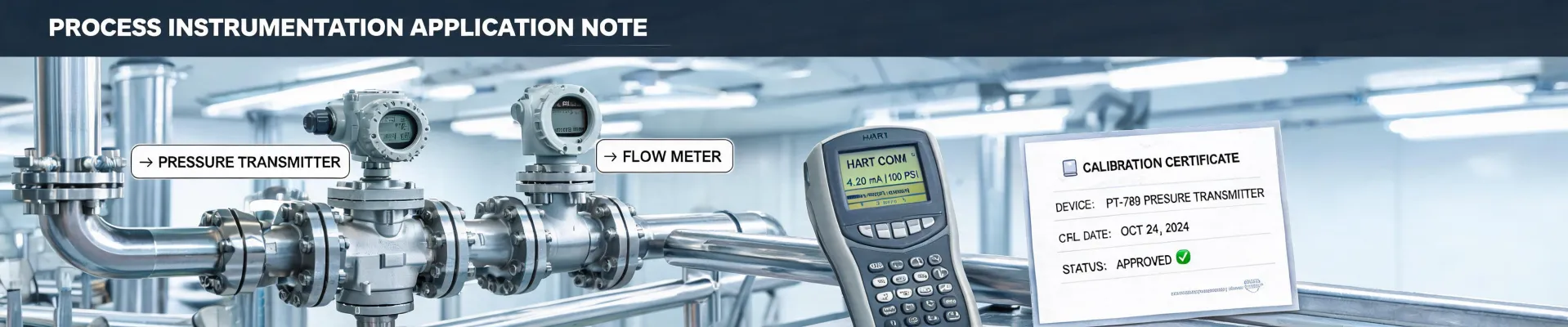
It's not mechanical damage. It's calibration paperwork. In Q4 2024 alone, I rejected seven deliveries because the calibration certificate either didn't list the instrument serial number or showed a range wider than what we specified. The product looked fine. The certificate was the problem.
I knew I should have double-checked the cert with the PO before the instrument went to the warehouse. But I thought, "We've used this supplier for three years." The odds caught up with me. Now every contract requires the cert number to match the unit, and we verify it before the truck leaves.
NIST traceable is the phrase I look for. It means the calibration chain leads back to national standards (nist.gov). If a vendor says "certificate included" but the calibration range isn't listed, I treat it as a red flag.
Do I need an oscilloscope on a calibration bench?
Not for basic pressure and temperature work. But the first time you see a 4-20 mA loop with a noisy signal, a multimeter will show you the effect, not the problem. That's where an oscilloscope earns its space.
You don't need a lab-grade scope. A 50-100 MHz, two-channel digital scope is enough to catch ripple, grounding issues, and pulse problems in process signals. Spending $10,000 on a mixed-domain scope for HVAC sensors is overkill. The question isn't "is an oscilloscope useful?" It's "when will you use it?" For us, it's usually loop troubleshooting and verifying output stability during temperature changes.
Why is the 5810 centrifuge in so many lab equipment lists?
I have mixed feelings about copy-pasted lab specs. On one hand, the 5810 centrifuge is a proven workhorse — that's why it keeps showing up. On the other, I've seen it specified for labs that would be better served by a smaller, less expensive benchtop model.
When you're writing an instrument list, ask what the centrifuge is for. If you're spinning blood tubes, you need swing-bucket rotors and sealed lids. If you're doing PCR work, you might not need 4 x 250 mL capacity. The 5810-class machine makes sense when you have high throughput or large volumes. It doesn't make sense just because a template says so.
Also, check the rotor certification. I've received used 5810 units with rotors that had exceeded their rated cycles. That's a safety issue, not just a performance issue.
Which Fluke multimeter should I buy?
Let me start with what I'm not: I'm not an electrical engineer, so I can't tell you which Fluke multimeter is the lab-grade solution for every possible measurement. But from a quality review standpoint, I can tell you how to avoid buying more meter than you need.
For most HVAC and plant troubleshooting, the Fluke 117 is a solid answer. It has true RMS, low-impedance mode to stop ghost voltage, and enough accuracy for 4-20 mA checks when paired with the right lead setup. For someone who spends the day on process loops and motor drives, the 87V is worth the step up. It has better dc accuracy, a stronger transient voltage rating, and a larger display.
If you're asking "which Fluke multimeter should I buy" and the answer is "whatever is on sale," slow down. Look at your measured safety category (CAT III/CAT IV), resolution, and whether you need temperature. A basic 15B model can be enough for electrical checks, but if it's a daily work meter, don't go below CAT III 600 V.
My real advice: buy the one you'll carry. A meter in the truck saves more problems than precision on a bench.