-
Who This Checklist Is For
-
Step 1: Rip Up the Spec Sheet You Think You Need
-
Step 2: Don't Skip the Package Deal
-
Step 3: Verify the Specs in the Real World, Not Just in the Catalog
-
Step 4: Get a Firm Delivery Date in Writing (and a Back-Up Plan)
-
Step 5: Check the Invoice Before You Pay
-
Common Mistakes I Still See People Make
Office administrator for a 200-person company. I manage all industrial instrument ordering—roughly $120,000 annually across 8 vendors. I report to both operations and finance.
When I took over purchasing in 2020, I thought buying a pressure transmitter or a flow meter was simple: find the spec, compare prices, buy the cheapest. Three years and a few expensive mistakes later, I know better. Here's a 5-step checklist I now use for every order from dwyer or any other supplier. It's saved my team time, money, and sanity.
Who This Checklist Is For
This is for anyone who has to buy differential pressure transmitters, flow meters, level transmitters, or similar gear for a facility or plant floor. If you're juggling orders for engineers who need gear yesterday, and you're tired of playing middleman between a supplier's sales rep and your own accounting team—this is for you.
Step 1: Rip Up the Spec Sheet You Think You Need
Here's the thing: engineers love to over-spec. They'll write down a Dwyer Magnehelic differential pressure indicating transmitter model number they used once in 2018 and assume it's still the best option. It's not always wrong, but it's not always right either.
What to do instead: Don't just order the part number. Pick up the phone (or send a quick Teams message) and ask two questions: “What exactly are you measuring?” and “What's the environment like?”
I once ordered a $450 differential pressure transmitter because the request said “for high-temp.” Turned out the engineer meant the ambient temp in the room was warm, not the media temp. The standard $200 unit would have worked. I wasted $250 and two weeks of lead time.
Checkpoint: Before you search for a price, confirm the actual use case, not just the model number.
Step 2: Don't Skip the Package Deal
I used to order transmitters and then separately look for a cable, a power supply, and the little mounting bracket. Separate orders from separate vendors. Three invoices, three shipping charges, three times the headache.
My rule now: For the first order with a new supplier, ask for a complete kit quote. For a flow meter or level transmitter, ask: “What do I need besides the instrument to get this running? Can you supply it all?”
I consolidated orders from 9 vendors down to 5. Processing 60-80 orders annually, that cut our receiving and accounting work by hours each month. When I switched to a single source for a Dwyer Magnehelic order—including the connecting tubing and hardware—I cut the receipt matching time from 30 minutes to 5.
Checkpoint: For every major instrument, ask if the supplier can supply the auxiliaries. Even if it costs slightly more, the administrative savings are real.
Step 3: Verify the Specs in the Real World, Not Just in the Catalog
It's tempting to think you can just compare published specs. But identical specs from different vendors can result in wildly different outcomes. The 'always trust the datasheet' advice ignores the nuance of how a pressure transmitter behaves at the bottom of its range or in a vibration-heavy environment.
What I do: I keep a running list of questions I ask the supplier's tech support or sales engineer. For a differential pressure transmitter, I might ask: “If I'm measuring 0.5 inches of water at a line pressure of 100 psi, what's the real accuracy?”
I've seen a spec sheet claim 0.5% accuracy, but the fine print said that's at calibrated span. For a low-range application, the actual error was closer to 2%. That's a big difference for a critical HVAC process.
Checkpoint: Don't assume the spec sheet tells the whole story. Ask a specific application question before committing to an order.
Step 4: Get a Firm Delivery Date in Writing (and a Back-Up Plan)
In March 2024, I needed a humidity sensor for a cleanroom validation project. The regular supplier had a 2-week lead time. A new vendor promised 5 days. I went with the new vendor to save a week. They delivered on day 6. The project started late. The engineer was stressed. I looked bad.
I went back and forth between the “cheaper, faster” option and the established vendor for two days. The cheaper option offered speed; the established one offered reliability. Ultimately chose the new one because I wanted to save the week. Should've stuck with the vendor I knew.
My rule: For any instrument needed by a specific date, I ask: “What's your on-time delivery rate for rush orders?” If they can't give a number, I move on. I also ask: “If you can't deliver on the promised date, will you cover the cost of an expedite from another source?”
Approved the rush fee on that humidity sensor order and immediately thought “did I just make the wrong call?” Didn't relax until the delivery arrived, even though it was a day late.
Checkpoint: Verify the delivery promise and the escalation path before you place the P.O.
Step 5: Check the Invoice Before You Pay
This sounds obvious, but I've been burned. In 2021, I ordered a Dwyer Magnehelic gauge and a few spare diaphragms. The invoice showed the gauge price correctly, but the spare parts were billed at $35 each instead of the quoted $18. It was a $68 error on a $300 order.
According to USPS (usps.com), business correspondence can be sent for $0.73 per ounce. For larger documents, a 1-oz flat costs $1.50. Those costs are minor compared to the time spent chasing a billing error, but the principle applies: check every line item.
Take this with a grain of salt: I'm not 100% sure this was malicious. It was probably a data entry error. But I flagged it, and they corrected it. If I hadn't checked, that $68 would have vanished into the department overhead.
Checkpoint: Match the P.O., the packing slip, and the invoice before submitting for payment. It takes 5 minutes per order. That saved me roughly $800 last year in billing errors alone.
Common Mistakes I Still See People Make
- Assuming standard means simple. A standard level transmitter might need a specific mounting flange or a different output signal. Always verify the connection type.
- Chasing the cheapest price on a single order. A $50 savings on a flow meter disappeared when I spent an hour trying to get a custom invoice from a vendor who didn't have electronic billing. Finance rejected the expense report. I ate the cost out of the department budget. Now I verify invoicing capability before placing any order.
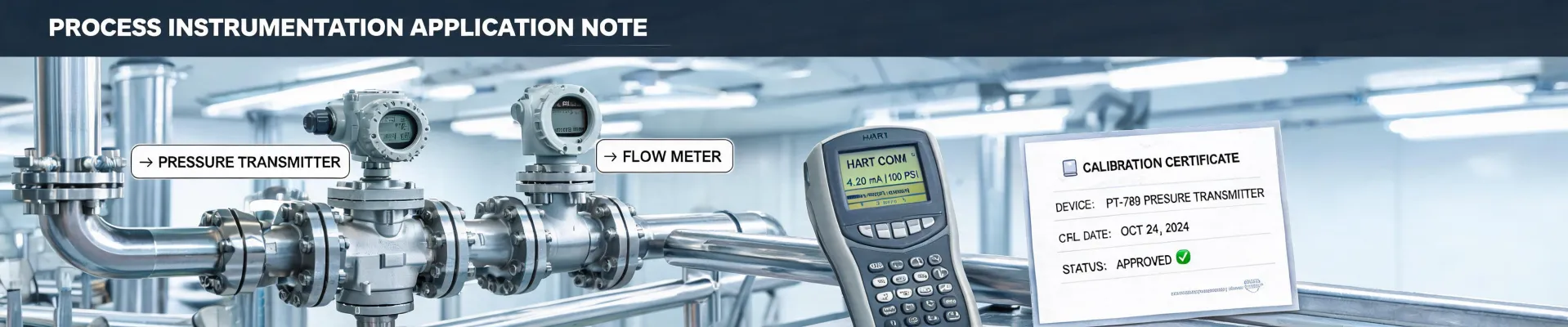
- Not asking about calibration. Some instruments come with a calibration certificate, some don't. If you're using a differential pressure transmitter for a compliance-related measurement, you need the cert. Ask upfront.
That's the list. Five steps. Each one is boring and practical. But following them has turned instrument ordering from a source of constant headaches into a smooth, predictable process. And in a B2B operation, that kind of predictability is worth paying for.